

Listen to Article
Education
00:00
Education
The Bahá’í writings place a special emphasis on the importance of education, describing it as the “primary, the most urgent requirement” for achieving the prosperity of nations. Bahá’u’lláh states: “Knowledge is as wings to man’s life, and a ladder for his ascent. Its acquisition is incumbent upon everyone.” “Every child is potentially the light of the world—and at the same time its darkness.” ‘Abdu’l-Bahá adds, “wherefore must the question of education be accounted as of primary importance.”
He further writes: “The education and training of children is among the most meritorious acts of humankind and draweth down the grace and favor of the All-Merciful, for education is the indispensable foundation of all human excellence and alloweth man to work his way to the heights of abiding glory.”
A growing number of individuals and communities around the world, inspired by these principles, are undertaking a wide variety of educational initiatives, ranging in complexity from informal after-school tutorials to universities. They include classes for children in kindergartens and primary schools that explore moral principles, literacy projects for youth and adults, education and training for women and girls, programs aimed at enhancing capacities of young people to promote social well-being, and organizations offering post-secondary education programs, developing curricula, or providing teacher training. Additionally, hundreds of Bahá’í-inspired academic schools have been established worldwide. Regardless of the form they take, all such educational endeavors have as their primary objective the release of human potential—assisting generation after generation to cultivate the qualities of heart and mind that can enable them to understand the world around them and contribute to the betterment of society.
“Knowledge is as wings to man’s life, and a ladder for his ascent. Its acquisition is incumbent upon everyone.”
—Baháʼu'lláh
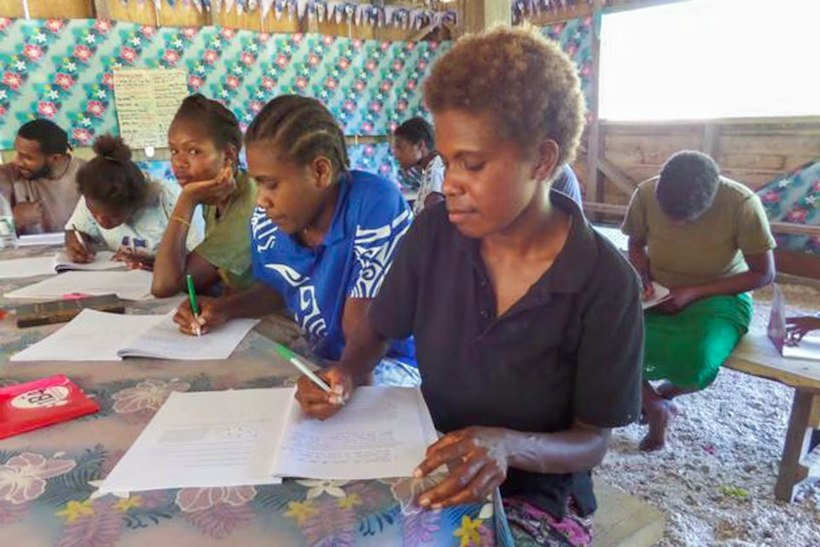
One of the fruits of the Bahá’í community’s commitment to education is the development, since the mid-1990s, of a global network of some 330 national and regional training institutes. The training institute is conceived as an educational agency whose purpose is to assist individuals to gain the spiritual insights and practical skills they need to serve their communities. In tens of thousands of localities, groups of people from all walks of life are engaged in a participatory process of study, action, and reflection aimed at enhancing the spiritual life of their communities. The courses of the training institute help the individual enter into the conversation of what the Bahá’í community has learned through experience as it has explored the Bahá’í writings and endeavored to contribute to the progress of society. More crucially, the courses seek to involve the individual in this process of learning and in the generation and diffusion of relevant knowledge.
In most parts of the world, as groups of individuals engage in this educational process and begin to carry out acts of service aimed at the common good, one of the first concerns that emerges is to ensure that children and youth in their communities have access to a sound academic education. Diverse informal initiatives have sprung up, including one-on-one or group tutorial assistance, simple literacy classes, and peer groups for homework help and further study. In a growing number of places, more sustained initiatives that lend further structure to the delivery of tutorial assistance and draw on a variety of interested volunteers in the community have been a natural outcome. Local Bahá’í institutions have also taken steps to collaborate with teachers and educational institutions to collectively work for the well-being of all the young people in a community.
Beyond such informal efforts, the establishment of schools has been a significant feature of Bahá’í experience in the field of development stretching back to the beginnings of the Faith in Iran and evolving in different parts of the world through the years. The page on Schools includes a few examples of such educational initiatives. Further, since the early 2000s, an approach has emerged through the experience of a number of Bahá’í-inspired organizations in Africa working for the promotion of community schools. The efforts of one such organization are discussed in an article on the Evolution of a Development Organization, and the various elements of this approach, as it has been refined through a collective learning process on the continent, are described in the section on Systematization of Learning. Given the important role that teachers play in society and how vital their contribution is to the education of the younger generation, teacher training is a theme that runs across all of these formal educational initiatives—a topic that is discussed in an article on Teacher Training, as illustrated through the example of an organization in Uganda. The last few decades have also seen a steady accumulation of experience in the area of tertiary education. Some examples of universities and organizations offering post-secondary programs are included on the page on Tertiary Education Projects. Within this wide range of educational endeavors, those aimed at learning to release the potential of young people to contribute to the betterment of society occupy a special place. While they fall within the broader area of education, they are explored in a section dedicated to Releasing the Potential of Youth.
Tutorial center, Dominican Republic
During the period of lockdowns caused by the coronavirus pandemic, a group of individuals in the San Juan province of the Dominican Republic initiated a project to help meet the educational needs of children in the community. The Florece Project serves close to 40 children from ages 5 to 11, drawing on teachers and volunteers from the community who provide tutorial support around a range of subjects, including literacy, mathematics, English, and art.
Supporting kindergartens, Mongolia
Established in 1993, the Mongolian Development Centre carries out programs that respond to the need for quality spiritual and intellectual pre-primary education. The organization supports teachers in government kindergartens to strengthen the quality of teaching. This has naturally led to additional lines of action, including training for parents and principals. As of 2022, the organization was working with educators at 29 kindergartens throughout Mongolia and reaching more than 4,500 children. The Centre has also collaborated with schools and officials in the country to host spaces for contributing to the discourse on the education of children in Mongolian society.
Student hostel, Thailand
A hostel is run in Omkoi, Thailand, for students from the Karen ethnic group who live in the surrounding areas but are too far away to commute from home to school. Some 50 students stay at the hostel, which pays attention to their spiritual and intellectual well-being and offers them a training program to supplement the education they receive at school. In addition to supporting their academic education, the program engages them in opportunities for service in surrounding villages and neighborhoods. Given that the hostel has been in operation for almost two decades, several former students who went on to obtain university education have returned to offer their support to the project.
Literacy, Philippines
In 1991, the Dawnbreakers Foundation was established in the Philippines to support the education of populations within the country. For over a decade, it has been assisting teachers to tend to the well-being of children through the promotion of community schools and learning about building the capacity of youth to contribute to the betterment of their communities. Included in its efforts has been learning how to increase literacy within the indigenous Mangyan population. Part of its approach has been to engage youth and young adolescents in the study of moral education texts that aim to improve language capabilities, and to assist them to carry out educational activities in their villages at increasing levels of complexity. In one village, the community is building a simple facility to serve as a venue for local gatherings as well as training, in order to reduce the distance young people would typically travel to engage in educational programs.
Literacy, Ghana
In the mid-1990s, the Bahá’í community of Ghana initiated a moral education and literacy campaign entitled “Enlightening the Hearts” in several regions of the country. The effectiveness of this experience led to the establishment of the Olinga Foundation for Human Development in 2001, which has extended the reach of the campaign to students of public schools. The organization collaborates with district education offices in addressing high illiteracy rates among upper primary students in rural regions. Teachers are trained to help students improve reading and writing skills in the local language over a period of nine months. In addition to receiving training on the organization’s methodology for literacy instruction, the teachers study materials that are aimed at building their moral capabilities and improving attitudes toward teaching. Through the influence of the program, cases of corporal punishment have been completely eliminated in several schools, and greater attention is being given to the educational needs of girls.
Parent education, United States
Parent University was established in 2000 in the United States with an aim of helping families in low-income neighborhoods of Savannah to take greater ownership of the education of their children and to assist them to overcome certain social issues facing the local population, such as poverty and relatively low access to formal educational opportunities. The organization offers a variety of courses to parents as well as other members of the extended family that equip them with the knowledge and skills required to create environments that are conducive to their children’s learning. Parent University has more recently started to offer a new multi-session module called “Early Learning College,” tailored to parents of children aged five and below. Some 3,000 individuals have thus far participated in the courses offered by Parent University.