

Contributing to the Discourse on Development at Various Levels
For the Bahá’í community, the expanding network of activities described in the foregoing pages has had significance well beyond the immediate benefits for those involved. The experience of applying principles found in the writings of the Bahá’í Faith to a wide range of situations has enabled the Bahá’í community and its collaborators to progressively gain insight into the current challenges in the development field and equipped it to contribute ever more confidently to the global discourse taking place.
The purpose of Bahá’í participation in various discourses is not to persuade others to accept a Bahá’í position on this or that subject. Nor is effort in this area of endeavor pursued as a public relations activity or an academic exercise. Rather, Bahá’ís are eager to share what they are learning in their efforts to apply Bahá’u’lláh’s teachings to contribute toward the advancement of civilization and to learn with and from other individuals and groups about how to respond to the common concerns facing humanity.
Contributions of Individuals
At any given moment, and in social spaces at all levels of society, there are ongoing conversations concerned with various aspects of humanity’s well-being and progress. At the local level, the involvement of individuals in discussions relevant to social progress as well as the cultivation of capacities to engage in meaningful conversation on spiritual themes are a natural part of efforts to build vibrant communities.
This could range from an act as simple as introducing Bahá’í concepts into everyday conversations to more formal activities such as the preparation of articles and attendance at gatherings dedicated to themes of social concern. Such conversations enhance collective understanding of the nature of the challenges a community faces and can shed light on possible avenues for constructive action. Countless individuals have also, through their professional and voluntary efforts, contributed to dialogues related to the common good.
Bahá’í-Inspired Organizations and Schools
Bahá’í-inspired organizations also contribute to discourses pertinent to their work. While such an orientation is generally present from the earliest stages of an agency’s efforts, opportunities to participate in relevant conversations and fora grow naturally together with an agency’s accumulating experience.
A number of Bahá’í-inspired schools and agencies in India, for instance, have been learning to contribute to conversations around education at the local and national levels. In Sikkim, several Bahá’í-inspired schools have extended invitations to other schools in the wider community to learn how to better serve their society, collectively identify some of the challenges they face, and unlock the potential of the young students they serve. These consultative gatherings have resulted in greater support and collaboration between the schools—including through the sharing of insights and resources—in what was previously a more competitive environment. Recently, some of the schools involved in this initiative have been invited to offer their thoughts regarding state policy in the area of education and have been interviewed by a number of media outlets on the subject.
The Bahá’í Chair for Studies in Development at Devi Ahilya University in Indore, which was established nearly 30 years ago, promotes interdisciplinary research as well as scholarship in the field of development from a perspective that regards human prosperity as an outcome of both material and spiritual progress. As part of this work, the Chair has been hosting seminars on themes pertinent to development challenges in the country including education policy, agriculture, local economic growth, and climate change, and has published research papers focusing on how communities and organizations make use of spiritual principles in their efforts to contribute towards the common good.
“Religion is the outer expression of the divine reality. Therefore, it must be living, vitalized, moving and progressive.”
—‘Abdu’l-Bahá
In Luxembourg, Unity Foundation is a Bahá’í-inspired organization that specializes in identifying and working with like-minded donors on behalf of agencies in Africa, Asia, and Latin America that have reached a certain level of programmatic and administrative capacity. One of the Foundation’s most significant donors is the Ministry of Foreign Affairs. A core feature of the Foundation’s approach involves respecting the independence of the development organizations with which it partners. It establishes relationships of mutual collaboration and learning in which it serves as an advocate for its partners in front of donors. In recent years, the organization has been learning how to contribute to the discourse on development within Luxembourg, drawing on insights gained by the agencies with which it collaborates. In this regard, its efforts are focused on promoting a constructive dialogue about principles underlying development. In various spaces—whether with donors, schools, in communities, in the media, or in other events open to the general public—participants are invited to explore themes such as justice, mutual support, gender equality, and overcoming prejudice, as well as to consider the application of these principles in their own lives. The Foundation also participates in different gatherings of Luxembourgish NGOs and invites these organizations to meet on a regular basis to reflect on the insights they are all gaining through experience.
International Level
The Bahá’í International Community (BIC) has been engaged for decades in several discourses related to the betterment of society within the United Nations (UN). In more recent years, it has participated in fora associated with the African Union, the Association of Southeast Asian Nations, the European Union, and other supranational groupings. Among the discourses it engages in are those concerned with global governance, development, equality of women and men, peace and security, the role of religion in society, human rights, the environment and climate change, food security, and the role of youth.
The BIC also regularly participates with government diplomats, UN agencies, and civil society actors in international conferences and nongovernmental fora such as the UN Commissions on Social Development and on the Status of Women and the United Nations Climate Change Conferences, to name a few. Over the years, the BIC has also published numerous statements addressing concepts relevant to the discourses mentioned above. As long ago as the mid-1990s, a major document that was released and that continues to assist at various levels is The Prosperity of Humankind. The document examines the concept of global prosperity in the context of the Bahá’í teachings. It presents an exploration of essential matters such as the nature and purpose of the development process as well as the different roles assigned to its various protagonists.
Among the more recent statements of the BIC, A Governance Befitting: Humanity and the Path Toward a Just Global Order was released on the occasion of the 75th anniversary of the UN. The statement explores dimensions of governance—particularly considering how the international community can strengthen its systems of global cooperation and recast its affairs in light of the oneness and interdependence of the human family in order to respond to global challenges and seize unprecedented possibilities in the coming years.
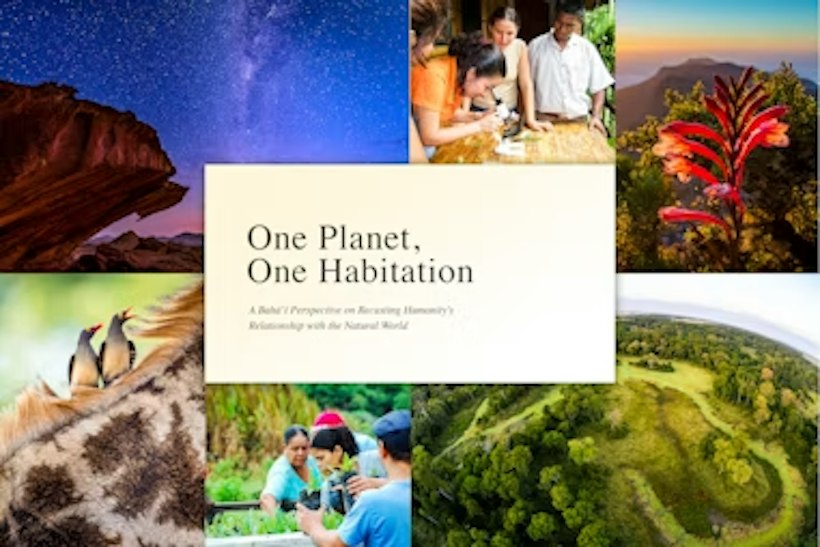
Another statement, One Planet, One Habitation: A Bahá’í Perspective on Recasting Humanity’s Relationship with the Natural World, was released on the occasion of the 50th anniversary of the 1972 United Nations Conference on the Human Environment. Drawing on the experiences of several national communities as well as the specialized knowledge of Bahá’ís involved in environmental action, the document explores how advancing a materially and spiritually flourishing civilization in harmony with the natural world is central to the human sense of meaning and purpose. The statement has been used by various Bahá’í communities to contribute to relevant conversations at the local and national levels and has since been complemented with other resources sharing the experience of several communities, including Colombia, the Democratic Republic of the Congo, Dominica, the Navajo Nation in the United States, Singapore, Vanuatu, and Zambia.
In addition to the efforts of the BIC, the Institute for Studies in Global Prosperity, established at the close of the twentieth century, provides a permanent forum for ongoing, in-depth exploration of concerns relevant to the advancement of civilization. One of its first initiatives involved sponsoring a series of colloquia on science, religion, and development in several countries in Asia, Africa, and Latin America. As a continuation of its earlier work, the Institute collaborates with like-minded individuals and institutions in exploring vital themes such as peace and justice in societies in transition, the global movement of populations, the role of religion in migration, and the growth and development of cities. It shares its findings, often in association with the Bahá’í International Community, in the form of publications and at colloquia of various kinds—this, with the aim of bringing to the forefront of public discourse ideas that point to enduring social change.
“The publication of high thoughts is the dynamic power in the arteries of life; it is the very soul of the world.”
—‘Abdu’l-Bahá
No serious observer can fail to appreciate the need for the massive investments of human and material resources that governments and organizations of civil society dedicate to promoting the well-being of the human race; nor indeed to value the intelligence and spirit of idealism that animates this work. Committed to the further expansion and enhancement of its development endeavors, the Bahá’í community continues to refine its vision that learning and capacity building lie at the heart of successful development. Such a vision calls for engaging people everywhere, from all walks of life and representing the full diversity of the human family, in the generation and application of knowledge. Spiritual principles and the methods of science, together, can mediate such engagement. It is in sharing the insights thus acquired, as a result of systematic experience, that the community believes its most useful contribution to the discourses on development must ultimately lie.