

Eswatini
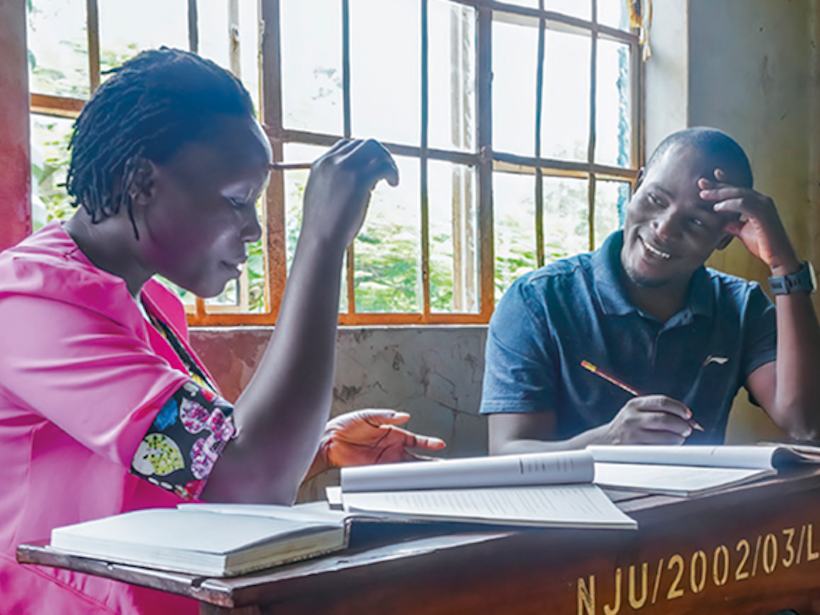
The Setsembiso Sebunye Foundation has been supporting community schools in Eswatini for over a decade. Initially, it helped to identify localities where conditions were propitious for the emergence of community schools, but over time, a number of new communities began to approach the organization themselves. In one such place, the inhabitants of the Mqolo village in the Hhohho region contacted the Foundation to request for a prospective educator, whom the population itself had identified, to participate in the teacher training offered by the organization. While the individual was receiving training, the community began constructing a classroom on the land donated by the village chief. In a gathering called for by local leaders, everyone was encouraged to contribute. Bricklayers and electricians from within the community offered their skills; many, particularly the youth, volunteered to collect water and build a structure; and others cooked meals for those involved. Once the Mqolo Preschool was established, the community continued to support it by providing food for the children and covering the teacher’s salary, expressing in various ways its appreciation for the teacher and ongoing concern that the youngest members of their community receive a holistic education.
Indonesia
Through the work of community schools in Indonesia, various actors are becoming increasingly involved in the processes of education in their localities. In many places, the education of young children had not always been perceived as closely related to the responsibility of village government, but over time, the connection between teachers, schools, and the local government has strengthened. A pattern is beginning to emerge where teachers are actively involved in processes concerned with the advancement of the community, and members of local government are engaging in activities at the schools. Members of the Department of Education have actively participated in seminars for teacher training, and additional spaces involving the local community and government have provided opportunities for consultation, planning, and action around preschool education and the development of capacity in the village.
Parents are similarly becoming increasingly involved in the education of their children. Seminars are being held with parents in collaboration with local government to foster their connection to the processes of education. In some instances, materials have been developed to assist them to reflect on the nature and importance of education, encompassing topics such as the role of parents as well as more holistic conceptions of education.
Malawi
Inhabitants of many localities in Malawi have taken responsibility for sustaining community schools and consulting about their ongoing development, including the well-being of teachers and the overall health of students. With the support of school management committees, many communities have established school gardens to provide food for the children. Where the land to establish plots is not sufficiently large to provide for the entire student population, families and other members of the community often contribute maize, soya beans, or groundnuts to assist the school. Participation involves members of the entire community, not only those whose children attend the community schools. At the level of institutions, existing community groups that give attention to village development have come together with the management committees to consider the progress of the schools.
The influence of the schools has also started to extend to surrounding localities. For instance, teachers often provide extra tutorial classes to children from other schools who need additional help. Further, the organization supporting community schools in the country, the Bambino Foundation, has worked together with local government, like-minded organizations, and other schools to foster the education of young people in rural communities by providing in-service training to teachers and encouraging measures to increase access to preschool education.
“The education and training of children is among the most meritorious acts of humankind...”
—‘Abdu’l-Bahá
Chad
The collaboration between the teachers and the community in the Guéra region of Chad led to a rise in consciousness of the importance of early childhood education. In L’École Nouvelle Vision — one of the community schools being supported by Fondation Ilm, a Bahá’í-inspired organization — strengthening bonds of friendship between teachers and parents has enabled the school to become a learning center for all. A literacy course has been organized for parents and other adults, mainly women, in the community to learn to read and write in French. The Foundation has also begun to train a few members in several communities in an agricultural program to establish a garden plot close to the community school. Further, when most schools closed owing to the health crisis caused by the coronavirus pandemic, teachers of community schools found ways to offer intellectual and spiritual education to children as well as further strengthen ties with parents within the localities in which they live. They also assisted with the provision of reliable information to the population concerning the pandemic and prevention measures.